Rubyvoquer
Peak Module
Peak Module
Couldn't load pickup availability
Helpful Course Details
- 📚 Long-term material availability
- 🔐 Secure checkout
- ↩️ 30-day payment return terms
- 💾 Downloadable study files for offline learning
Self-paced learning overview
1. Problem Statement
When a learner has already covered many separate Ruby topics, they may feel that the knowledge is there, but it is difficult to apply it inside one organized solution. A single method may be clear, arrays and hashes may be familiar, and conditions may not be new, but together they require careful organization. The move from a short example to a fuller task often creates the largest number of questions. A learner may begin writing code and then notice that the structure has become hard to read. Peak Module is created for these situations: when the goal is not only to review a topic, but to bring several ideas into one calm and readable learning module.
2. Solution
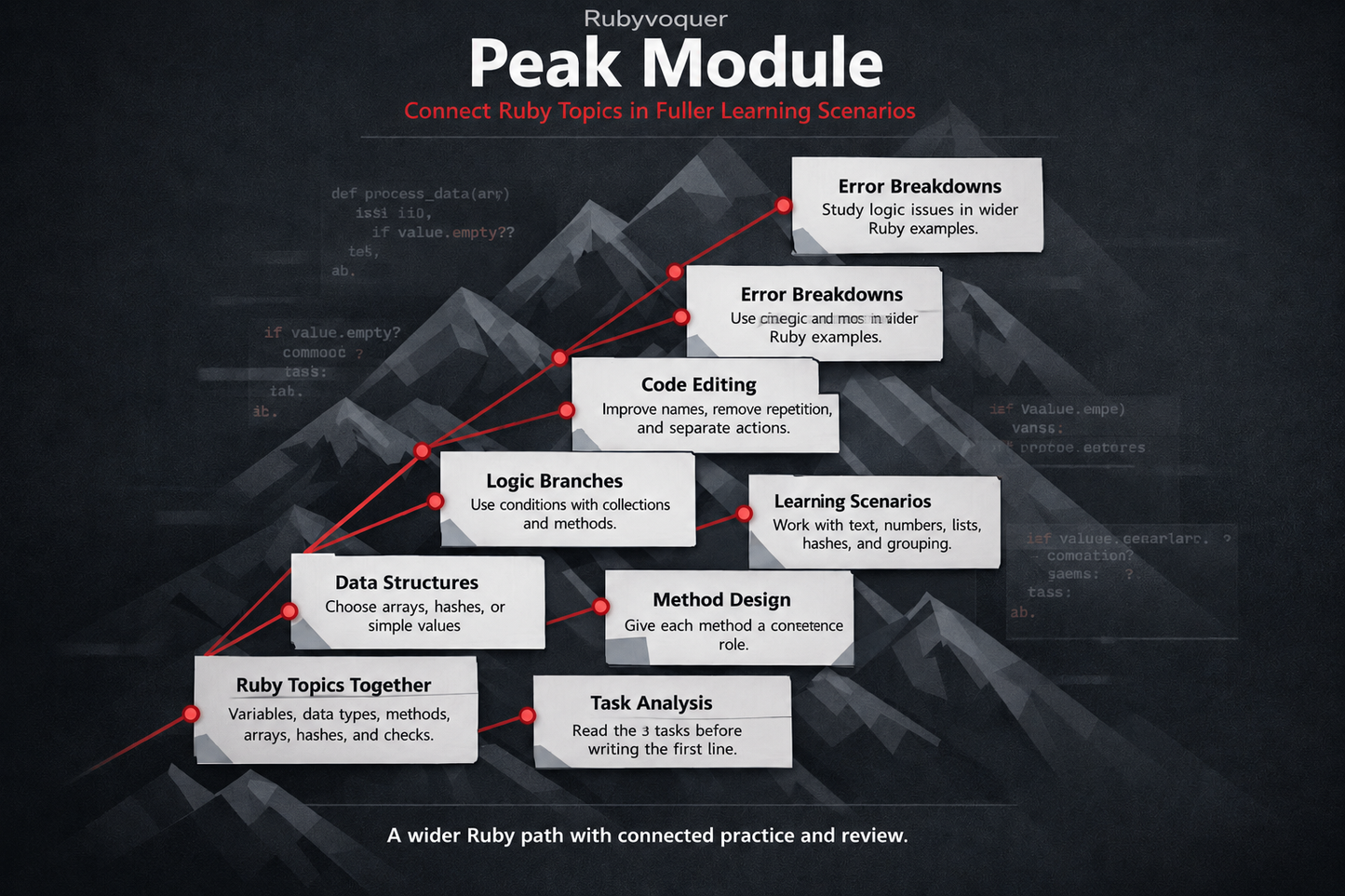
Peak Module presents Ruby through connected modules where each task moves through several stages: task breakdown, data structure choice, method writing, logic check, collection processing, and review of the finished code. The materials help learners see not only Ruby lines, but also the overall shape of a solution. This plan gives more attention to how code parts interact with one another. Learners work with examples where the order of actions matters and where several different roles should not be mixed inside one method. This approach supports attentive practice and helps learners understand Ruby through ordered learning tasks.
3. What’s Inside
Peak Module includes a broad set of materials for learners who want to work with Ruby through complete learning modules. Each module is built around a separate topic or a combination of topics, but they all follow a shared logic: first breakdown, then building, then checking and editing.
The first block focuses on modular thinking in Ruby. Learners practice seeing a task as a set of connected parts: data, checks, methods, collections, result, and review. The materials explain why it is helpful not to mix everything into one large fragment and how to divide a task into readable parts.
The second block focuses on data preparation. It covers examples with strings, numbers, arrays, and hashes. Learners see how to shape data before processing, how to separate preparation from the result, and how not to change a structure when creating a new value would be clearer.
The third block focuses on methods with clear roles. The materials show how to create methods that perform one understandable action: checking a value, processing a list, forming text, counting items, or returning a prepared result. A separate part looks at how to avoid loading a method with extra conditions.
The fourth block looks at collections in connected tasks. Arrays and hashes are used for storing, choosing, grouping, counting, and preparing a result. Learners work with study examples where several steps are needed: receive a list, choose items, check values, and form a new structure.
The fifth block focuses on conditions inside modules. It shows how checks can affect different parts of a solution. Learners see when a condition can remain in the main fragment and when it may read better as a separate method with a clear name. This helps make code calmer to read.
The sixth block contains tasks with many steps. Each task includes a sequence: read the description, write down the data, choose structures, create methods, write checks, receive the result, and review the code. Topics cover text, numbers, lists, hashes, counting, filtering, and grouping.
The seventh block focuses on editing code after writing. Learners receive fragments that work but include repetition, unclear names, or mixed actions. The materials show how to make the solution tidier step by step: clarify names, separate methods, remove extra lines, and simplify conditions.
The eighth block breaks down common logic mistakes. It explains situations where Ruby syntax is correct, but the result differs from what was expected: a method returns a value too early, data changes in an awkward place, a hash is read with an inaccurate key, a condition is placed in the wrong part, or a loop performs an extra action.
Peak Module also includes a map called “Ruby solution module.” It helps learners move through a task by stages: description, data, structure, methods, checks, processing, result, review. This is a useful guide for learning practice when a task is no longer very short and needs careful order.
A separate review section is included as well. It helps learners return to topics that often raise extra questions: method parameters, returned values, working with arrays, reading hashes, checks, nested structures, and editing longer Ruby fragments.
4. Who Is This For?
Peak Module is for learners who already know the main Ruby topics and want to work with them in a more organized format. This plan fits those who want to see not only a separate example, but the whole path from task description to review of the finished solution.
It is suitable for people who often ask: “How do I bring all of this into one piece of code?” The materials help break a task into parts, choose a structure, write methods, and check whether the solution reads well after completion.
Peak Module also fits learners who want more practice with Ruby code editing. Here, it is important not only to create a fragment, but also to return to it: look at names, action order, repetition, method roles, and result clarity.
5. What You’ll Learn
- How to see a Ruby task as a set of connected parts.
- How to prepare data before processing.
- How to create methods with one understandable role.
- How to work with arrays and hashes in fuller tasks.
- How to choose a data structure based on task meaning.
- How to place conditions without extra complication.
- How to combine checks, methods, and collections.
- How to form a result through several stages.
- How to read a longer Ruby fragment in parts.
- How to notice logic inaccuracies after writing code.
- How to edit a solution for better later reading.
- How to work with learning modules where several topics are connected in one process.
6. 30-Day Payment Return Terms
- 30-day money back
- - Risk-free
What format are the materials in?
What format are the materials in?
The materials are provided in a digital format: text modules, PDF-style guides, Ruby code examples, and practice files that can be downloaded for offline study.
Do I need any prior programming knowledge?
Do I need any prior programming knowledge?
No prior programming knowledge is needed for the starter plans. The materials begin with core ideas: variables, strings, numbers, conditions, arrays, hashes, and methods.
Share