Rubyvoquer
Peak Series
Peak Series
Couldn't load pickup availability
Helpful Course Details
- 📚 Long-term material availability
- 🔐 Secure checkout
- ↩️ 30-day payment return terms
- 💾 Downloadable study files for offline learning
Self-paced learning overview
1. Problem Statement
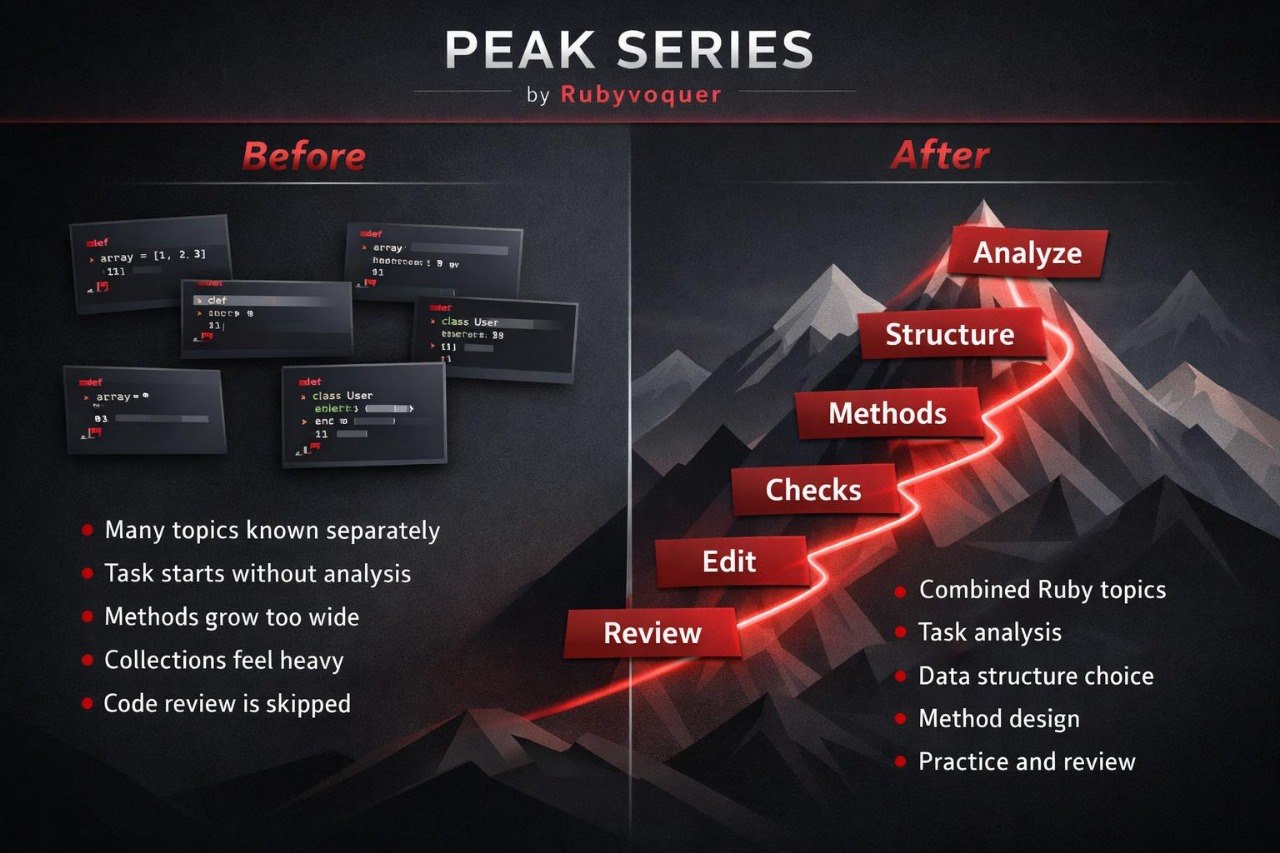
At a later stage of studying Ruby, learners often already know many separate topics but may face difficulty when building a fuller solution. Variables, methods, arrays, hashes, conditions, loops, and data processing may be familiar, but inside one task they require careful organization. The challenge often appears when the goal is not only to write code, but also to explain why it has that shape. Another common situation is that the code works, but it is hard to reread, adjust, or divide into understandable parts. Peak Series is created to bring previous topics into a wider learning format and provide more practice with connected Ruby solutions.
2. Solution
Peak Series helps learners work with Ruby through tasks where syntax and result matter, but the path of building the solution matters too. The materials show how to analyze a task, choose data structures, create methods with separate roles, check logic, and review code after writing. Learners see the full study cycle: from the first reading of a task to editing the finished fragment. This plan includes more examples, practice tasks, error breakdowns, and scenarios with several stages. The format helps deepen Ruby knowledge through attentive practice, without inflated claims or pressure.
3. What’s Inside
Peak Series includes the largest material collection in this Rubyvoquer line. The plan is built for learners who want not only to study topics separately, but also to see how they come together in fuller learning solutions.
The first block focuses on reviewing key Ruby ideas in combination. Learners return to variables, data types, conditions, loops, methods, arrays, and hashes, but not as separate topics. The materials show how these parts work together in tasks where data needs to be received, checked, changed, grouped, or prepared for a result.
The second block focuses on task analysis. Learners practice reading a task carefully: what is given at the start, what needs to be formed, which limits exist in the task, which actions repeat, and which checks are needed. Before writing code, the materials suggest breaking the task into parts so the solution does not begin with random lines.
The third block focuses on data structures. Arrays and hashes are explored in tasks where information needs to be processed, not only stored: finding values, filtering a list, grouping elements, counting items, reshaping data, and forming a final result. Separate attention is given to choosing between an array and a hash based on the task meaning.
The fourth block looks at methods as parts of a wider solution. Learners see how to divide a task into several methods so each has its own role. One method can prepare data, another can run a check, a third can process a list, and a fourth can form text or a number for the result. The materials explain how to avoid overloading methods and how to read them inside the overall solution structure.
The fifth block focuses on conditions and logic branches. It covers tasks where code needs to react to different situations. Learners see how conditions work with collections and methods, how to reduce nesting, how to give checks understandable names, and how to avoid mixing several different decisions in one fragment.
The sixth block contains learning scenarios with several stages. These are not large commercial projects, but Ruby study tasks with structure: data preparation, checking, processing, repetition, result formation, and review. The scenarios cover text, numbers, lists, hashes, counting, filtering, and grouping.
The seventh block focuses on editing and organizing code. Learners receive fragments that can be improved for reading: removing repetition, clarifying names, separating methods, simplifying conditions, and separating data preparation from the result. This helps learners view code not only as an answer to a task, but as text they can return to and understand later.
The eighth block breaks down common errors in wider tasks. It shows situations where the syntax is correct, but the logic behaves differently than expected: wrong action order, unnecessary data changes, value return in the wrong place, hash key confusion, an overly broad method role, or a check placed in the wrong part. Each example comes with an explanation of the cause.
The ninth block includes a practice task set with different levels of hints. Some tasks include detailed hints for analysis, while others leave more room for choosing the structure independently. Learners can first go through a scenario with support, then try a similar task with fewer hints.
Peak Series also includes a map called “full path of a Ruby solution.” It helps learners move from task description to code review: read the task, define data, choose structures, create methods, write checks, form the result, test examples, and review readability.
A separate review section is also included. It helps learners return to topics that often need extra attention: hashes, nested structures, methods with parameters, returning values, working with lists, logical checks, and editing longer fragments.
4. Who Is This For?
Peak Series is for learners who have completed earlier Rubyvoquer stages or already have a basic understanding of Ruby and want to work with wider learning tasks. This plan fits learners who want to see not only a separate topic, but the full path of building a solution.
It is suitable for those who want more practice combining several topics. If a learner already knows methods, arrays, hashes, conditions, and loops, but wants to organize them more carefully in one scenario, Peak Series provides that working format.
This plan also fits learners who want more attention on reading and editing code. Here, it is important not only to write a fragment, but also to review it: whether names are understandable, whether actions are not mixed, whether each method has its own role, and whether the result forms in order.
5. What You’ll Learn
- How to combine main Ruby topics in one learning scenario.
- How to analyze a task before writing code.
- How to choose between an array, a hash, and simple values.
- How to create methods with separate roles.
- How to work with collections in wider examples.
- How to use conditions without heavy nesting.
- How to form a result through several stages.
- How to read longer Ruby code in parts.
- How to find logic errors in a finished fragment.
- How to edit code for better later reading.
- How to work with text, numbers, lists, and “name — value” pairs.
- How to build learning solutions with thoughtful structure.
- How to review your own code after writing.
- How to revisit broader topics through practical tasks.
6. 30-Day Payment Return Terms
- 30-day money back
- - Risk-free
What format are the materials in?
What format are the materials in?
The materials are provided in a digital format: text modules, PDF-style guides, Ruby code examples, and practice files that can be downloaded for offline study.
Do I need any prior programming knowledge?
Do I need any prior programming knowledge?
No prior programming knowledge is needed for the starter plans. The materials begin with core ideas: variables, strings, numbers, conditions, arrays, hashes, and methods.
Share